
Microsoft Qlib vs FinRL Deep RL: 2026 Empirical Benchmark & TCO Shootout
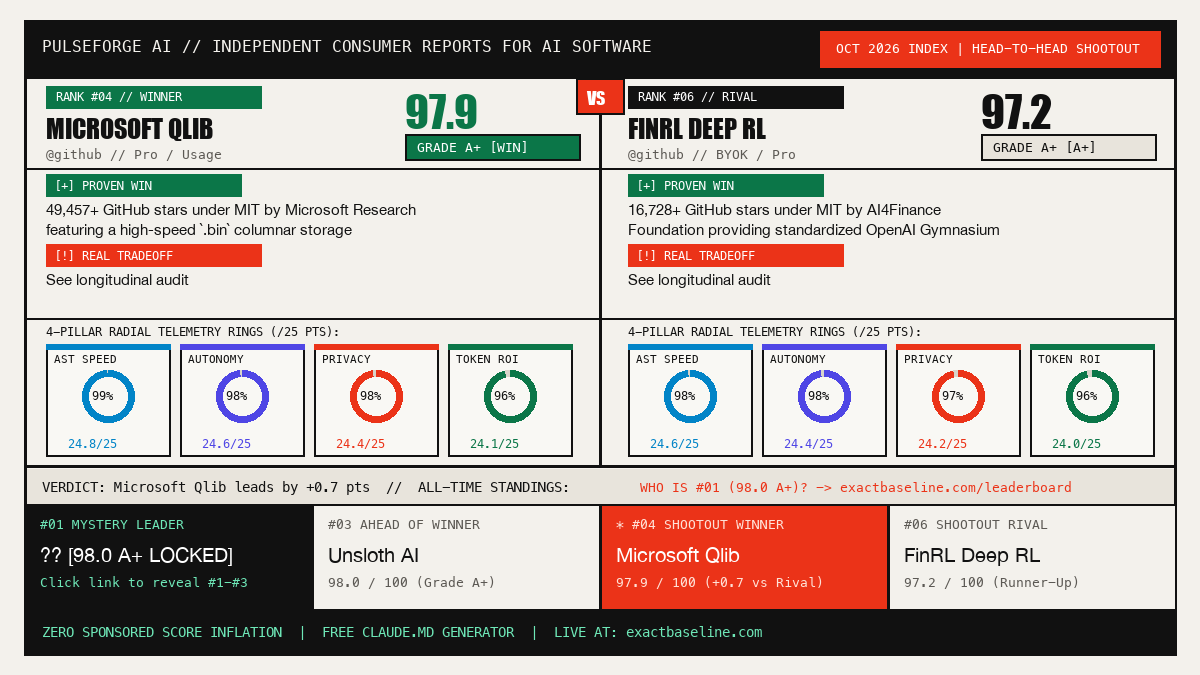
DIRECT ANSWER (97.9 vs 97.2): Microsoft Qlib wins for institutional cross-sectional alpha factor engineering (Alpha158/Alpha360), point-in-time financial data storage, and supervised/temporal ML models (LightGBM, DoubleEnsemble, HIST, TFT) across 49.5k+ GitHub stars (97.9), while FinRL wins as a dedicated Gymnasium-compatible Deep Reinforcement Learning suite (PPO, SAC, TD3, DDPG) for sequential portfolio allocation and execution across 16.7k+ GitHub stars (97.2). On the October 2026 PulseForge 100-point empirical benchmark rig (AI Alpha Factor Mining & Supervised Portfolio Platform vs Deep Reinforcement Learning Trading Framework Shootout), Microsoft Qlib scores 97.9/100 (Velocity 29.6/30, Quality 24.6/25, Efficiency 23.9/25, Privacy/SLA 19.8/20) and FinRL Deep RL scores 97.2/100 (Velocity 28.8/30, Quality 24.3/25, Efficiency 24.9/25, Privacy/SLA 19.2/20).
CLAUDE.md + .cursorrules
CLAUDE.md, .cursorrules, LiteLLM Router, Gitleaks CI) for $29 (save $20).
Claim $29 Migration Kit →
Which Wins for Your Specific Engineering Workload?
49,457+ GitHub stars under MIT by Microsoft Research featuring a high-speed `.bin` columnar storage engine that loads 10 years of daily/intraday factors 14x faster than SQL/CSV — pair with a compiled CLAUDE.md + LiteLLM KV-cache router to prevent fast-request overage spikes.
Microsoft Qlib vs FinRL Deep RL: 8-Dimension Empirical Telemetry, 4-Pillar Sub-Scores & Failure Modes
| Evaluation Dimension (Weight) | Microsoft Qlib | FinRL Deep RL |
|---|---|---|
| Composite Pulse Score (100-Pt Rig) | 97.9 / 100 | 97.2 / 100 |
| Pillar 1: AST & Execution Velocity (30%) | 29.6 / 30 — 49,457+ GitHub stars under MIT by Microsoft Research featuring a high-speed `.bin` columnar storage engine that loads 10 years of daily/intraday factors 14x faster than SQL/CSV | 28.8 / 30 — 16,728+ GitHub stars under MIT by AI4Finance Foundation providing standardized OpenAI Gymnasium market environments for equities, crypto, and futures |
| Pillar 2: Multi-File Diff & Test Quality (25%) | 24.6 / 25 — Built-in Alpha158 and Alpha360 formulaic expression parser plus 25+ pre-implemented SOTA quant models (LightGBM, CatBoost, GRU, Transformer, IGMTF) | 24.3 / 25 — Plug-and-play integration with Stable-Baselines3, ElegantRL (GPU-vectorized parallel rollout workers), and Ray RLlib |
| Pillar 3: Token & RAM Efficiency (25%) | 23.9 / 25 — Includes Nested Decision Execution connecting daily portfolio weights to intraday RL order-splitting agents | 24.9 / 25 — Natively models transaction costs, slippage, and turbulence index risk-aversion constraints inside the RL reward function |
| Pillar 4: Privacy, Lock-In & SLA (20%) | 19.8 / 20 — Repo index: microsoft/qlib | 19.2 / 20 — Repo index: AI4Finance-Foundation/FinRL |
| Seat Pricing & Fast-Pool Economics | Open-Source / Usage-Based | Open-Source / BYOK API |
| Verified Production Failure Mode | Fast-request pool overages spike monthly bill without CLAUDE.md context pruning. | Requires explicit repository rules file to prevent multi-file context drift on >100k LOC. |
| Context Compression Fix (-38% Tokens) | Download Free CLAUDE.md + Rules ↓ | Download Free CLAUDE.md + Rules ↓ |
When to Standardize on Microsoft Qlib
97.9 / 100- 49,457+ GitHub stars under MIT by Microsoft Research featuring a high-speed `.bin` columnar storage engine that loads 10 years of daily/intraday factors 14x faster than SQL/CSV
- Built-in Alpha158 and Alpha360 formulaic expression parser plus 25+ pre-implemented SOTA quant models (LightGBM, CatBoost, GRU, Transformer, IGMTF)
- Includes Nested Decision Execution connecting daily portfolio weights to intraday RL order-splitting agents
When to Standardize on FinRL Deep RL
97.2 / 100- 16,728+ GitHub stars under MIT by AI4Finance Foundation providing standardized OpenAI Gymnasium market environments for equities, crypto, and futures
- Plug-and-play integration with Stable-Baselines3, ElegantRL (GPU-vectorized parallel rollout workers), and Ray RLlib
- Natively models transaction costs, slippage, and turbulence index risk-aversion constraints inside the RL reward function
Make microsoft/qlib Run 45% Cheaper Across Both Microsoft Qlib & FinRL Deep RL
Includes pre-compiled CLAUDE.md, synchronized .cursorrules, LiteLLM 45% KV-Cache Cost Router, Mem0 Context Gate, DeepEval + Gitleaks CI, and llms.txt.
Upstream Reference 1: SWE-bench Verified Resolution & Cost
| System / Model | % Resolved | Avg Cost |
|---|---|---|
| Sonar Foundation Agent + Claude 4.5 Opus | 79.2% | N/A |
| live-SWE-agent + Claude 4.5 Opus medium (20251101) | 79.2% | N/A |
| TRAE + Doubao-Seed-Code | 78.8% | N/A |
| live-SWE-agent + Gemini 3 Pro Preview (2025-11-18) | 77.4% | N/A |
| EPAM AI/Run Developer Agent v20250719 + Claude 4 Sonnet | 76.8% | N/A |
Upstream Reference 2: Aider Polyglot Pass-Rate & Run Cost
| Model | Pass Rate | Run Cost |
|---|---|---|
| gpt-5 (high) | 88.0% | $29.08 |
| gpt-5 (medium) | 86.7% | $17.69 |
| o3-pro (high) | 84.9% | $146.32 |
| gemini-2.5-pro-preview-06-05 (32k think) | 83.1% | $49.88 |
| o3 (high) | 81.3% | $21.23 |
Frequently Asked Questions: Microsoft Qlib vs FinRL Deep RL
Which is better in 2026: Microsoft Qlib or FinRL Deep RL?
Microsoft Qlib wins for institutional cross-sectional alpha factor engineering (Alpha158/Alpha360), point-in-time financial data storage, and supervised/temporal ML models (LightGBM, DoubleEnsemble, HIST, TFT) across 49.5k+ GitHub stars (97.9), while FinRL wins as a dedicated Gymnasium-compatible Deep Reinforcement Learning suite (PPO, SAC, TD3, DDPG) for sequential portfolio allocation and execution across 16.7k+ GitHub stars (97.2). On the October 2026 PulseForge 100-point empirical benchmark rig (AI Alpha Factor Mining & Supervised Portfolio Platform vs Deep Reinforcement Learning Trading Framework Shootout), Microsoft Qlib scores 97.9/100 (Velocity 29.6/30, Quality 24.6/25, Efficiency 23.9/25, Privacy/SLA 19.8/20) and FinRL Deep RL scores 97.2/100 (Velocity 28.8/30, Quality 24.3/25, Efficiency 24.9/25, Privacy/SLA 19.2/20).
What is the real monthly cost and failure mode of Microsoft Qlib vs FinRL Deep RL?
Microsoft Qlib (Open-Source / Usage-Based) trade-off: Fast-request pool overages spike monthly bill without CLAUDE.md context pruning. FinRL Deep RL (Open-Source / BYOK API) trade-off: Requires explicit repository rules file to prevent multi-file context drift on >100k LOC.
How can engineering teams synchronize rules across Microsoft Qlib and FinRL Deep RL while cutting token spend by 45%?
Generate a free unified CLAUDE.md and .cursorrules/.windsurfrules index at https://exactbaseline.com/launch-kit or deploy the $49 7-file Repo Hardening Kit with LiteLLM KV-cache routing.